



Duel Autocare
The Microfibre FlosserFor Gaps Too Tight For A Brush
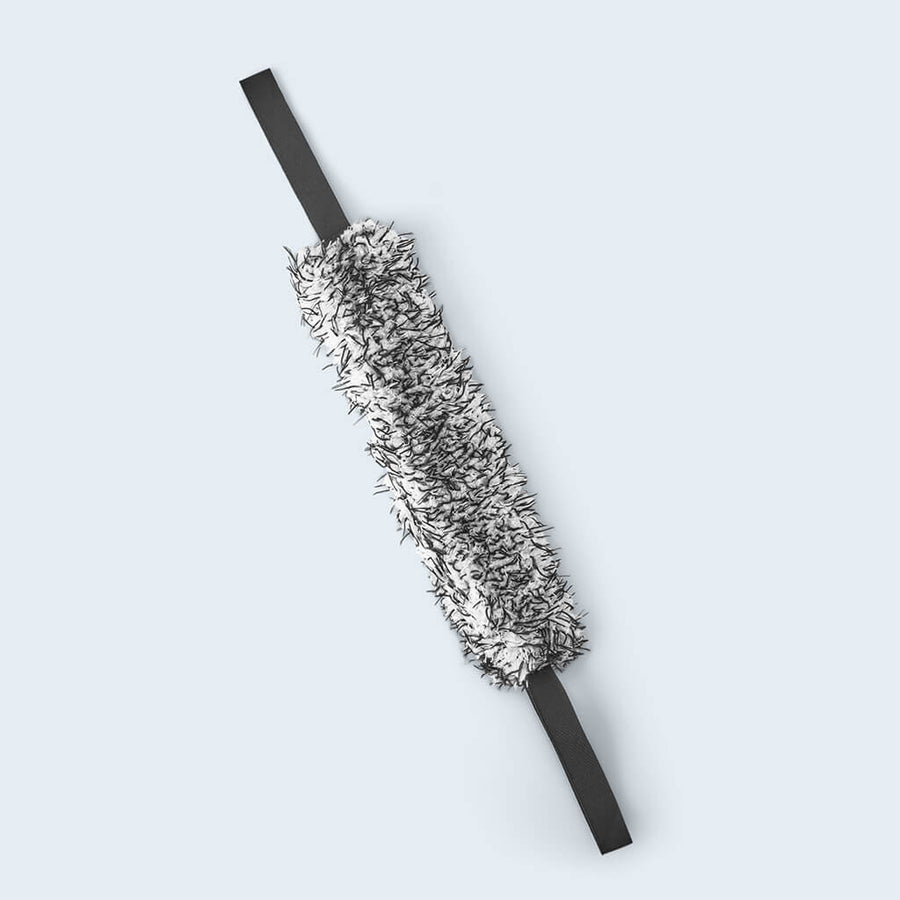
Every car has places a brush cannot get to. The gap behind a wheel spoke, the slot between a grille and a bumper, the inside lip of an exhaust tip, the shadow behind a door handle. The Flosser is built for exactly those: a slim nylon handle with a flexible double-sided microfibre strip that threads into a gap and pulls back and forth, so the fibre does the cleaning rather than the bristle. Washable, reusable, and just as useful on a motorbike or a mountain bike as on a car.
At A Glance
Why You'll Love It
A brush is bristles on a stick, and a stick has a minimum thickness. The Flosser is a flexible strip. Thread it through the gap, take an end in each hand, and pull. That is a different action entirely, and it works in spaces a brush cannot enter.
Behind a wheel spoke or around a badge you are working blind, close to finished surfaces. A soft double-sided microfibre strip lifts dirt without the risk of dragging a bristle tip across paint you cannot see.
The strip is microfibre on both faces, so every pass cleans in both directions. There is no wrong way round and no wasted stroke.
Machine wash it with the rest of your microfibre and it comes back like new. This is a tool you buy once, not a consumable.
What Does A Flosser Actually Do That A Brush Cannot?
A detailing brush cleans by sweeping. Bristles are held rigid by a handle, the handle has a minimum diameter, and the bristles need room to move. That combination sets a hard limit on how narrow a space a brush can work in. Below that limit, the brush either does not fit or its tips are the only part making contact, which is both ineffective and the point at which a bristle can mark a finish.
Flossing is a completely different mechanism. The strip is flexible, so it goes in edge-on through a gap far narrower than any brush head. Once through, you hold an end in each hand and draw it back and forth. The fibre is pressed against the surface by the tension in the strip rather than by a handle, so contact pressure stays even along the whole length, and it stays even around a curve.
That is why it works on the shapes that defeat brushes: the barrel side of a wheel spoke, the slot between a grille and a bumper, the inside lip of a twin exhaust tip, the recess behind a door handle, the cable runs and brackets in an engine bay. On a motorbike or a mountain bike, where almost the whole machine is tubes, cables and linkages, it stops being a niche tool and becomes the main one.
"A brush cleans by sweeping. A flosser cleans by threading through and pulling. Below a certain gap width, only one of those is possible."
— Duel AutocareIs It Right For You?
- Wheel spokes, barrels and the faces behind them
- Exhaust tips, including the inside lip
- Grilles, vents and the slot behind a front bumper
- Badges, trim edges and the recess behind door handles
- Mirror caps and the gap behind them
- Engine bay cables, brackets and hose runs
- Motorbikes and mountain bikes, where most of the machine is tube and linkage
- Anyone who already owns brushes and keeps finding places they will not reach
- You are cleaning open wheel faces and arches — that is brush work, and the EZ Detail GO Brush covers far more area far faster
- You are washing panels — use a wash mitt
- You are wiping down flat interior or exterior surfaces — a General Purpose cloth at £1.65 is the right tool
- You want to scrub tyre walls — that is a stiff brush job
- Painted and lacquered surfaces
- Alloy, chrome and painted wheels
- Exhaust tips
- Grilles and plastic trim
- Glass
- Engine bay components (cold)
- Bike frames and drivetrains
- Hot exhausts and hot engine components — let the car cool first
- Sharp edges and split trim, which can catch and tear a strip
- Dry use on a dirty surface — always work wet with a cleaner or shampoo
- Keep the one you use on wheels separate from the one you use near paint
How To Use The Flosser
One wash at 30°C with Duel Laundry clears manufacturing residue and opens the fibre.
Wet the area first with your shampoo, wheel cleaner or degreaser, and let it dwell. The Flosser lifts dirt that has already been loosened. Dragging it across dry grit is how you mark a surface with any microfibre.
Feed the strip into the gap side-on rather than face-on. It goes through openings far narrower than the strip is wide.
Draw it back and forth in short strokes, the same motion as dental floss. Let the tension press the fibre onto the surface. You do not need to force it.
Work along the length of the gap rather than scrubbing one spot. A few passes in several positions beats a lot of passes in one.
Rinse the strip in clean water when it loads up, particularly on wheels. A loaded strip carries grit, and grit is what causes marks.
30°C with Duel Laundry, separately, air dry. Brake dust and degreaser do not rinse out with household detergent.
Flosser Or Detailing Brush?
| Microfibre Flosser (this one) | EZ Detail GO Brush | |
|---|---|---|
| Cleans by | Threading through and pulling | Sweeping |
| Contact surface | Double-sided microfibre strip | Soft bristles |
| Minimum gap it fits | Anything the strip fits through edge-on | Limited by the brush head diameter |
| Best at | Narrow gaps, curved recesses, behind things | Open faces, wheel barrels, arches, volume |
| Reach for it when | A brush will not physically go in | You have area to cover and access to cover it |
| Speed over large areas | Slow | Fast |
| Price | £9.99 | £17.99 |
These are not alternatives, they are sequence. The brush does ninety per cent of the wheel and the Flosser does the ten per cent the brush cannot reach. Anyone who details properly ends up owning both, and the Flosser is usually bought by someone who already has brushes and has run out of ways to get behind something.
Products That Work With The Flosser
Frequently Asked Questions
What is a microfibre flosser?
How is it different from a detailing brush?
Can I use it on my alloy wheels?
Will it scratch my paint or wheels?
Can I use it on a motorbike or a bicycle?
How do I wash it?
Care Instructions
 Wash 30°C
 No Bleach
 No Tumble Dry
 No Iron
 No Dry Clean
 No Softener
Not classified as hazardous. No SDS required for textile products.
- Machine wash at 30°C with Duel Laundry microfibre wash detergent
- Do not use fabric softener or dryer sheets
- Wash separately from other fabrics
- Air dry — do not tumble dry
- Do not bleach · Do not iron · Do not dry clean
Technical Specification
| Product type | Microfibre detailing tool |
| Handle | Nylon |
| Cleaning surface | Double-sided microfibre strip |
| Length | 32cm strip + 15cm straps each end (62cm overall) |
| Strip width | 8cm |
| Fibre blend | 100% polyester |
| Colour | Black handle |
| Supplied | Single |
| Suitable for | Alloy, chrome and painted wheels, exhaust tips, grilles and vents, badges and trim, mirror caps, engine bay components (cold), motorbikes and bicycles |
| Wash | Machine wash 30°C with microfibre detergent · do not use fabric softener · wash separately · air dry · do not tumble dry, bleach, iron or dry clean |